
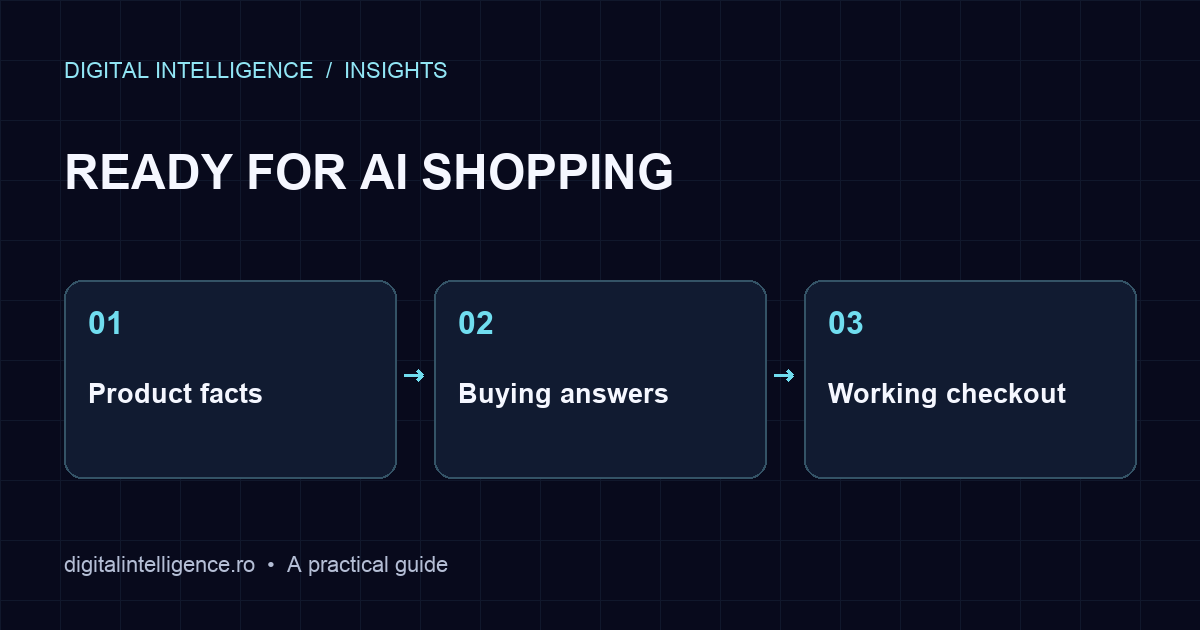
Start with one commercially important category. Fix inconsistent product facts and buying information before commissioning a new AI checkout integration.
What has changed—and what applies in Romania
In its 16 September 2026 shopping update, Google expanded its agentic commerce plans. Agentic commerce means software helping shoppers carry out parts of a purchase, rather than only recommending a product. The announcement places new checkout integration capabilities in the US, with Australia and Canada to follow in early 2027. Its Merchant Center AI performance insights list five markets; Romania is not one of them.
For a Romanian retailer, this is a reason to prepare reliable product information, not to assume every announced feature is available locally. Before paying for an integration, confirm the supported country, commerce platform and account eligibility. Ask what customers will actually be able to do on launch day.
Audit the product information customers depend on
Choose a category that matters to your business and inspect a small sample covering different variants, prices and stock states. Open the product page, the feed entry and the checkout side by side. Record discrepancies before rewriting anything.
Scroll the table sideways to see every column.
| Check | Evidence to compare | Decision |
|---|---|---|
| Product and variant | SKU, brand, model, size or pack quantity | Can the buyer identify the exact item? |
| Price and availability | Visible page, selected variant, feed and basket | Do the values agree? |
| Buying information | Delivery terms, return information and contact route | Can the customer understand the conditions before paying? |
| Product evidence | Manufacturer specifications and current images | Can every material claim be supported? |
| Purchase path | Mobile selection, add to basket and checkout | Can a customer complete the intended task? |
Record the page URL, the problem, the evidence, the person responsible and the next check. A mismatch that affects the sale belongs ahead of a stylistic rewrite. This order keeps the project useful even if a new AI shopping feature never reaches your account.
Google’s product structured-data documentation describes how product markup can communicate details such as price and availability. Check that it represents the visible product and selected offer accurately. Markup is a description of the offer, not a substitute for a usable page.
Answer the buying question behind the query
A product description should help someone choose. “Premium quality for every occasion” gives little help to a person comparing dimensions, compatibility or pack sizes. Use actual enquiries and approved product facts to identify the questions that matter.
Keep variants easy to distinguish. If the same product comes in several sizes, explain what changes and what stays the same. Link to the relevant specification or manual when it helps the decision. Do not invent attributes to fill an empty field.
Google also documents optional conversational attributes, including product questions and answers and document links. Assess these after the core product data is reliable. Check the current specification and your feed setup before implementation; additional fields do not guarantee recommendations.
Check the mobile purchase path before increasing reach
Start from a product link on a phone. Select a variant, add it to the basket and continue far enough to check costs and available delivery options. Use your store’s agreed test procedure so the check does not accidentally create a paid order.
- Can customers see which variant they selected?
- Does the basket retain the correct item and quantity?
- Are unexpected costs or unavailable delivery options appearing late?
- Can people find an answer or contact you without losing their place?
If an external AI checkout becomes relevant later, ask who handles stock updates, payment confirmation, cancellations and support. A new purchase route needs an operational owner as well as technical integration. That is a separate project from improving product copy.
Measure the buying journey, not an “AI-ready” score
Save a baseline for the category you change: relevant visits, product selections, basket additions and completed orders where tracking supports them. Review abandoned journeys and recurring customer questions alongside the totals.
Record promotions, stock shortages, price changes and campaign activity. A seasonal increase in orders after a rewrite does not establish that the rewrite caused it. When order volumes are low, task-based checks and actual customer feedback can reveal problems before a numerical comparison becomes meaningful.
Keep AI visibility separate from purchases. A cited product page may help discovery, but a citation is not an order. Use the AI-search measurement guide to keep those measures distinct.
Turn the audit into a manageable project
A useful brief names the category, the pages, the source of product facts, who can approve claims and who will implement changes. It also identifies feed and checkout work that needs separate technical assessment.
For Digital Intelligence, an appropriate starting point can be an agreed website or online-store project, product copy or search improvements. A proposal should specify the deliverables and any specialist involvement. It should not promise a new commerce integration before the requirements are understood.
Start with the discrepancy list. Finish when the agreed changes are live, the product information matches and the buying journey has been checked. Then decide whether further work has a clear business case.
Sources for factual claims
- Google: September 2026 shopping update
- Google Merchant Center: conversational attributes
- Google Search Central: product structured data
Sources checked 9 October 2026. Plans, checklists and examples are editorial analysis, not client performance results.