
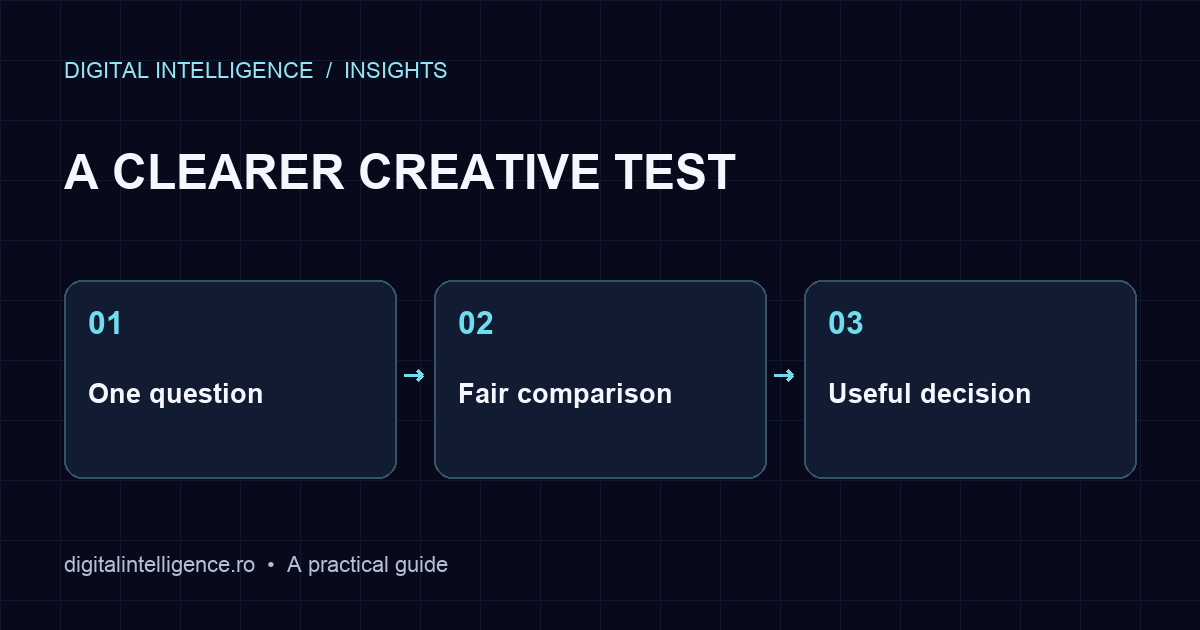
Choose one business question, keep the comparison as consistent as possible and decide in advance what evidence would justify continuing. More generated variants do not automatically create a better test.
What Meta’s latest AI tools change
On 6 October 2026, Meta announced broader rollout of Ads Creative Studio, creative insights in its business assistant and further campaign-assistance tests. Some features remain in testing or rollout. Check what your account actually supports before building a workflow around them.
The practical opportunity is to make and review creative options more efficiently. The business still needs to choose the offer, check the claims and decide how much it can spend learning. An assistant’s suggestion is an input to that decision, not evidence that an ad will sell.
Write the decision before you write the ads
A useful test question identifies a buying obstacle. “Which colour gets more clicks?” may be less useful than “Do customers respond better when we explain the product’s fit or demonstrate how it works?” Start from customer enquiries, sales conversations or the gaps on your landing page.
Write down one decision you will make after the test: continue a concept, revise it or stop spending on it. If every possible result leads to “make more ads,” the question needs work.
Use a test brief everyone can understand
Scroll the table sideways to see every column.
| Field | What to agree |
|---|---|
| Business question | The customer concern and the decision the test should inform |
| Comparison | The variable or complete concept that changes; what stays consistent |
| Primary outcome | A relevant purchase or qualified enquiry, with a clear definition |
| Budget and timing | Authorised spend, review date and conditions for stopping early |
| Evidence | Campaign results, landing-page behaviour and business-quality checks |
| Owner | Who approves claims, checks tracking and makes the next decision |
Limit the number of variants to what you can fund and review. If the account generates few useful outcomes, dividing the available spend across many options can leave every comparison inconclusive. There is no universal daily budget or fixed duration that guarantees a reliable answer for every business.
For a clearer causal comparison, use an appropriate controlled test available in the account and keep other conditions stable. Running several ads together and comparing their totals is an observational review, not automatically a controlled experiment. Check the test setup and its limitations before interpreting the result.
Review AI-generated creative before it reaches buyers
Check the product itself, not just the spelling. A generated image can change a detail that matters to a buyer; a copy variation can quietly turn a qualified statement into a promise. Compare each asset with approved specifications and the current offer.
- Does the image represent the item or service accurately?
- Are dimensions, included items, delivery claims and prices supportable?
- Is the message still clear when viewed on a small phone screen?
- Does the landing page deliver the same offer and next step?
- Are the people, music and assets appropriate for the intended use?
Save approved versions and record which one ran. If the platform can automatically adapt creative, review the options available and decide which changes are acceptable. A later review needs to know what customers could actually have seen.
Read results in the order that matters to the business
Start with the agreed outcome, then use clicks and other engagement measures to diagnose the journey. An ad can attract attention while bringing unsuitable enquiries. A lower cost per form submission is not necessarily a lower cost per suitable customer.
For lead generation, compare the recorded enquiries with the business’s qualification criteria. For an online store, review purchases alongside cancellations, returns and the costs relevant to that product. Keep platform attribution and business records clearly labelled when they disagree.
If one variant receives little delivery, “no purchases” may mean insufficient evidence. If an ad gets visits but the landing page is broken, pause and fix the journey before interpreting the creative. If tracking changes during the test, record it and reconsider whether the periods are comparable.
Choose a spend limit you can afford before launch. Stop early for a broken destination, an inaccurate claim or a tracking failure. Performance-based stopping decisions should follow the agreed test plan rather than reacting to every daily fluctuation.
Investigate fatigue before replacing everything
If results weaken, inspect the wider context: stock, price, audience, seasonality, landing-page changes and measurement. Repeated exposure and declining response can suggest creative fatigue, but a rising cost alone does not identify its cause.
Keep a simple creative log: concept, date launched, offer, relevant outcome, context and next decision. Retain a clear record of what you learned so the next round does not recreate the same uncertain comparison.
Digital Intelligence’s paid advertising services can include campaign planning, creative variations and management within an agreed scope. Bring the current campaign, the offer and the decision you need to make. The useful deliverable is a test you can understand and act on.
Sources for factual claims
Sources checked 9 October 2026. Plans, checklists and examples are editorial analysis, not client performance results.